Podcast: Play in new window | Download
OpenAI is building its partner ecosystem at a pace where a week feels like a month.
Subscribe to our Newsletter: https://theultimatepartner.com/ebook-subscribe/ Check Out UPX: https://theultimatepartner.com/experience/
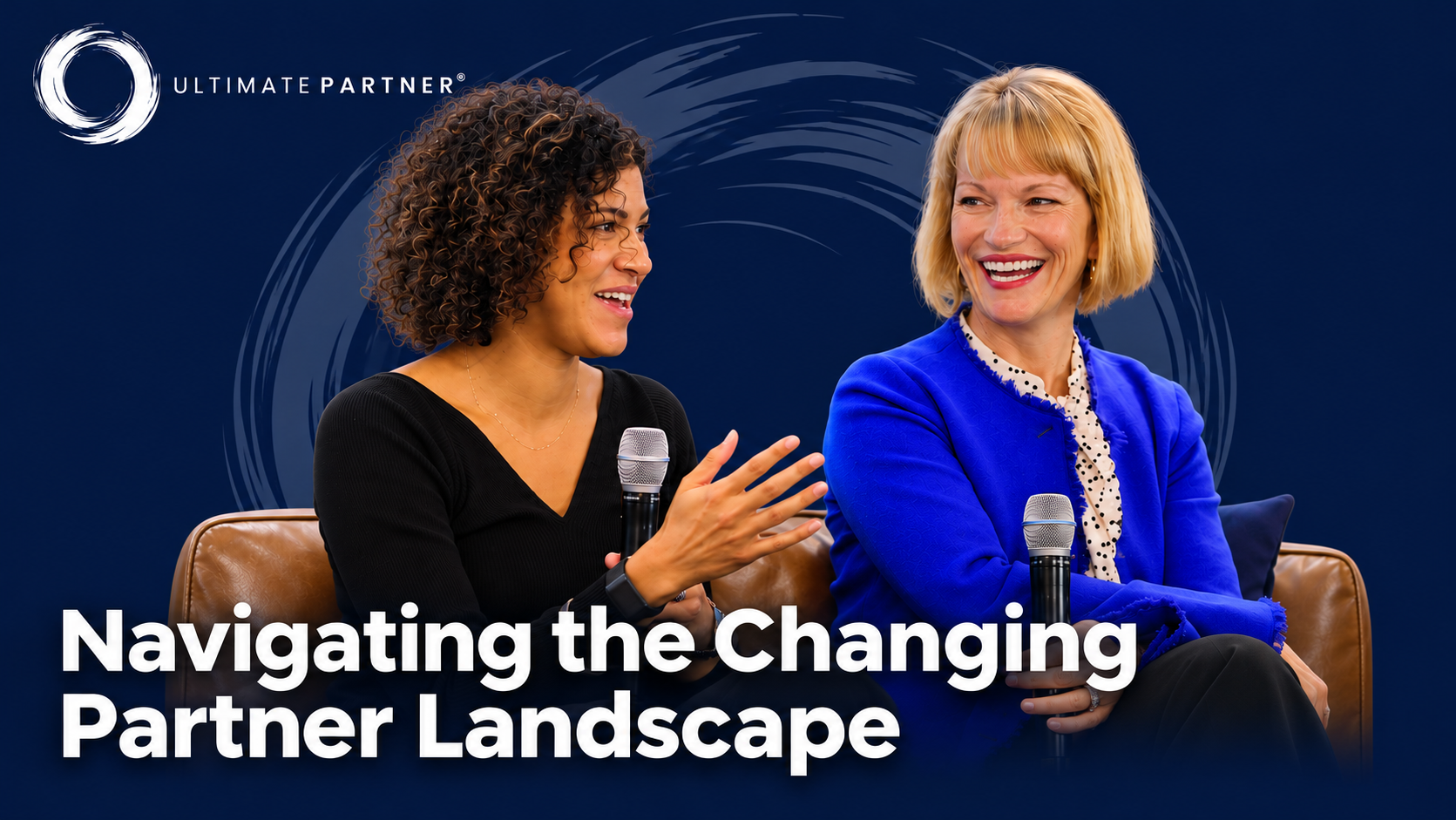
Frontier AI labs are becoming the newest hyperscaler-class partners, and the organizations that win with them are moving at a speed the channel has not seen before. In this session, recorded live at Ultimate Partner Live in Reston, host Vince Menzione sits down with Chelsea Berlucchi, who leads OpenAI’s North America partner ecosystem after eight years at Google and ten at Cisco, and Lori Borg, Chief Operating Officer of Eliza, a services firm built from scratch this year and focused entirely on OpenAI.
Chelsea describes an OpenAI partner network that has grown to more than 12,000 registered partners in a few months, a team organized around partner sales and partner management rather than tiers, and a co-sell motion built on direct-sales instincts: partners in the room with the account director, covering the whole customer organization, and pitching in five minutes rather than forty slides.
Lori explains why going all in on a single platform has paid off across her career, how Eliza structures itself around build-with, sell-with and market-with motions, and how industry depth and persona-led use cases let a small, nimble partner bring value faster than larger multi-cloud firms. The conversation closes with practical advice for partners who want a relationship with a frontier lab, the opportunity for MSPs on the day-two side of the business, and an audience question on how a Microsoft-only partner can add OpenAI through model choice and digital-native customers.
YOUTUBE: [add link]
Key Takeaways
- OpenAI’s partner network grew to more than 12,000 registered partners within months, almost entirely self-serve, and the North America team now aligns partners directly with account directors and sales engineers to co-sell.
- OpenAI does not tier its partners; the expectation is self-sufficiency fast, with the first meeting feeling like the third and the first month like the first year.
- Co-selling with a consumption-based AI business means revenue arrives only when workloads are delivered, so partners must be in the customer meetings, cover the whole organization, and plan the implementation jointly.
- Partners who succeed with OpenAI dedicate accountable people to the practice, invest in badging and forward deployed engineer training alongside OpenAI’s own teams, and bring a clear five-minute point of view on why customers choose them.
- A partnership built on trust runs on three motions at once: build with, sell with and market with. Eliza’s all-in focus on OpenAI accelerated that trust and earned grassroots champions inside OpenAI’s sales organization.
- Microsoft-centric partners can add OpenAI through model choice conversations and fast-growing digital-native customers, while MSPs have a natural opening in the day-two managed side of AI deployments.
If you’re ready to lead through change, elevate your business, and achieve extraordinary outcomes through the power of partnership—this is your community. At Ultimate Partner we want leaders like you to join us in the Ultimate Partner Experience – where transformation begins.
Keywords
OpenAI, partner ecosystem, frontier model, co-selling, account directors, partner network, forward deployed engineers, badging, all-in partner, build with, sell with, market with, consumption model, model choice, MSPs, digital natives, Eliza, Microsoft ecosystem.
Transcript
Chelsea Berlucchi – Lori Borg AUDIO PODCAST
[00:00:00] Chelsea Berlucchi: I want the first meeting to feel like the third meeting. And I want the end of the first month in a partnership to feel like the end of the first year. And to really think this business should be different.
[00:00:17] Vince Menzione: You can feel it happening. The ground is shifting beneath us. The way we partner, how AI is remaking the channel, and what it takes to win as a partner right now. I’m Vince Menzione, and welcome to the Ultimate Partner Podcast, where the leaders shaping the ecosystem tell you what’s really happening. Get ready to go deeper: the insights, the frameworks, the real moves in the market. Because being in the room changes everything, and we’re bringing the room to you now.
[00:00:48] Vince Menzione: I am thrilled to welcome our first guests up to the stage today. Both of these incredible leaders I’ve gotten to interview before in various forms, and I’m so thrilled to welcome them both. Chelsea Berlucchi, come join us. And Lori Borg, why don’t you come join us as well so we don’t have to do this twice? But so good to see you. So great to see you. Oh my goodness. And Lori, so great to see you.
[00:01:31] Lori Borg: You too. Great to be here.
[00:01:33] Vince Menzione: So I thought we’d start with introductions. I’ll let you introduce yourselves. I know you both well and your career, but I think maybe take us through your background, and Lori as well.
[00:01:38] Chelsea Berlucchi: Okay. Great. Hi, everyone. Chelsea Berlucchi. So I recently joined OpenAI to lead their North America partner ecosystem a little over 60 days ago. Just counting in days. Each day is kind of like a week. Each week is kind of like a month.
[00:01:54] Vince Menzione: I can imagine. The fire hose must be incredible.
[00:01:57] Chelsea Berlucchi: A lot going on. Prior to that, I was at Google for eight years, both in direct sales as well in the partner ecosystem. And then prior to that, I was at Cisco for 10 years, starting out my career in IT.
[00:02:08] Vince Menzione: So I love this just to visualize this because Cisco, we talked about Cisco, Jay talked about Cisco, like the quintessential channel company. And then you go to GCP, which is the quintessential hyperscaler company, and now OpenAI 60 days. And so really the quintessential AI company.
[00:02:24] Chelsea Berlucchi: Yeah, I’ve taken a lot of the foundations from Cisco, brought those over to Google. And then as I went into the channel at Google, I was able to then also transform that into what I’m bringing over to OpenAI and also what I’m learning there as well. So it’s been a fun journey.
[00:02:39] Vince Menzione: We’ll have an adaptability conversation in a moment. Lori, so good to welcome you.
[00:02:46] Lori Borg: Yeah, great to be here. So good to see so many faces. Good morning, everyone. I’m Lori Borg. I’m the Chief Operating Officer at Eliza. My background is a little bit different. I spent most of my career building Microsoft partner businesses in the Microsoft ecosystem. Having built and sold a few businesses, I then found myself at Microsoft as the Vice President for Go-To-Market for the Americas. And while I was inside of Microsoft, oh, I was just itching to get back out there and build another business, but a different kind of business. I left Microsoft a couple of months ago to join Eliza as Chief Operating Officer. And Eliza is a very, very focused OpenAI partner. So I have the privilege of working with Chelsea and the broader OpenAI team and can concur with everything that Chelsea said. We talk about it at Eliza: one week feels like a month, so I feel like I’ve been there already a couple of years.
[00:03:42] Vince Menzione: And it’s just been a couple of months. We’re moving really fast. But that’s a little bit about my background. It feels like Jay kind of teed up this conversation in a way. He really did in terms of FTEs, and we’ll talk more about your organization as well. But I thought we’d start with you. Everybody wants to know about what’s happening at OpenAI, and after 60 days, I’m sure you’re an expert in all areas of the company. Take us through what you’re doing. I mean, your remit is a pretty significant remit, North America.
[00:04:07] Chelsea Berlucchi: It is. It’s quite a bit. So I joined, again, over 60 days ago and was brought in by a former Google leader, Colleen Kapase, who is our global partner ecosystem leader. Colleen is best in the business. So if you’ve worked with her, if you haven’t, you should, absolutely should. She’s just been in the industries and understands, one, how to build out a business like this, how to build out a partner-first organization, how to meet with the right people to do it as well. So she brought me on. We had worked a bit together at Google, so she knew a little bit about my background. She was a great sponsor of mine. And as I came into the business, so much had already been done, which was great. There is this massive foundation. They built out a partner network. How do we get partners to join and to register? And they did that in around, I think, June or so of this year. And since then, over 12,000 partners have registered to become—yes, and counting. Literally, like I go in every day and I’m checking.
[00:05:10] Chelsea Berlucchi: The cool thing is they did that without calling and saying, “Hey, how do I do this?” They were just able to really self-serve. So that is one massive thing.
[00:05:18] Vince Menzione: All AI-generated, right? Because it’s all—
[00:05:20] Chelsea Berlucchi: Thousand percent. And then for me in particular, covering North America is really the remit of, okay, how do we align to the field sales team? So I have my team that does partner sales and really working with all of our account directors, which is what we call our account executives, and our AAAs, which is essentially what we call our systems engineers or sales engineers, to make sure that as they’re working with their customers, they have started that co-sell motion too. And it’s newer for OpenAI, but it may not be new for a lot of the individuals that are there already in go-to-market, the sellers and the engineers. So that’s good. At least they have brought that piece in from other businesses that they’ve worked at and said, “Yeah, I’ve worked with partners before. I have familiarity. I know what that strategy should look like.” So we’re taking them from maybe they could be an A+ player and understanding how to co-sell and making it better, maybe I’d give them a D in helping them a little bit. Sorry, Lori. You’re seeing it on your side, I’m sure, too. So that’s one. And then on the other side is really building out the partner management motion. And that is looking at partners that, so many of you are sitting in the audience right now and have started to build a practice with OpenAI, whether it’s because you were getting so many requests from your customers to say, “Hey, why aren’t you partnered with OpenAI? Can you help implement? Can you enable? Can you deploy?” Or maybe you just saw a spot in the market and said, “Oh, no, we’ve got to either pick a frontier lab or model or multi-models.” Totally fine, I get it. And then start to build out that particular practice too. And so it’s understanding from those partners where they have their investments, how they’re building their business, and then trying to translate what we’re up against at OpenAI as well to help them continue to craft and shape that. Because, like you said, drinking from a fire hose, things change literally by the hour. I think by the time I signed my contract to join and by the time I joined, we had a new CRO and all these other things that happened. Great news, the new CRO background at both Google and at Cisco, which was cool to come into. That’s my focus right now is really beefing up both parts of those businesses, but then also forcing myself to take a step back every now and then, too, because I have this opportunity to build, and I don’t want to always do things like they’ve been done before. I think we’ve all been there where you’re banging your head against the wall because you have customers that have asked you the same thing and you can’t solve for it, partners that have asked you for the same thing, you can’t solve for it, and then you’re kind of wondering, “Why is this even a function? I don’t have to do this.” So how do you then start and change the narrative, change the practice, change the strategy? And that is the fun part for me is getting to build and be creative again.
[00:08:14] Vince Menzione: Right. I’m taking the feedback. I’m taking the lessons learned, the bumps, the bruises from along the way, and then truly crafting something that’s next level. So how is your team—I’m sure everybody’s going to ask this if I don’t—so how is your team organized? Is it broken out by partner types, like the classic model or what you came from in your past? And how do you tier them as well?
[00:08:35] Chelsea Berlucchi: Yeah, great, great question. So we have our partner sales folks and our partner managers all under the name of a partner director. And then for my team, we do manage what we would typically in industry call our regional systems integrators. And so those are those partners outside of our GSIs. There’s a GSI leader that I’m a peer with, and she manages the 12 to 13 or so that they’ve named as our global systems integrators
[00:09:07] Chelsea Berlucchi: or global solutions integrators that are truly a global practice and that kind of do that end-to-end advisory, consulting, implementation.
[00:09:18] Vince Menzione: Which Jay was talking about earlier.
[00:09:20] Chelsea Berlucchi: Yes, he was talking about that earlier. And then on the other side of that, I have in my portfolio some very incredible partners, of course, that I think a lot of times our ADs or account directors are very attracted to working with these partners because they’ve been with customers for so long in their own technology journey
[00:09:38] Vince Menzione: Mhmm.
[00:09:39] Chelsea Berlucchi: and really have transformed their own business because they’re able to be nimble and really, again, keep an eye on where the market’s going. So I don’t tier our partners.
[00:09:50] Vince Menzione: Okay.
[00:09:51] Chelsea Berlucchi: This is a big thing for me too because, again, being at Google and just seeing how having partners give feedback, “Why am I not in this bucket? Why am I not over here?” And I’m thinking, this is just a title. Does this really matter? And so my message a lot of times to partners is that you may have an individual that I’ve decided to assign to manage this relationship. And then that person may be there for a quarter as you build out your OpenAI practice and you become more self-sufficient, your practice becomes more robust, you’ve built out your own relationships within OpenAI,
[00:10:26] Chelsea Berlucchi: and then you kind of have to, like, flap your wings, as you say to your kid when they leave the house, like, “Go,” and build the business. Continue. So to me, I want to move away from that Monday pipeline call, “Not much has happened since last Monday, Tuesday,” a couple of introductions. I want the first meeting to feel like the third meeting.
[00:10:47] Vince Menzione: Yep.
[00:10:48] Chelsea Berlucchi: And I want the end of the first month in a partnership to feel like the end of the first year. That’s how fast we are moving. The expectation is to be self-sufficient, is to use the technology, and to really think this business should be different. We want to deliver it differently to our customers. And so I’m also trying to manage the business differently as well.
[00:11:07] Vince Menzione: You also are expert at effective co-selling. We had you on the podcast way back. You and I have been on stage at Google events. And you’ve built the art and science around it, accelerating it even at GCP before you came over. So I’m interested how much of that you’re taking forward into this. You said get rid of the 40-slide deck and move to a five-minute of the brand and story conversation, like who you are, why are you relevant,
[00:11:36] Chelsea Berlucchi: what’s in it for you and what’s in it for us, right, that conversation. Right. I mean, spot on there. I think the big thing for me has been my background. I was in direct sales for 14 years before I went into the channel. And for anyone that has carried a bag, you never ever forget that feeling.
[00:11:53] Vince Menzione: Yeah.
[00:11:54] Chelsea Berlucchi: The pit in your stomach, you get your quota at the beginning of the fiscal year. That pit does not leave until you have line of sight to stretch, hopefully. Hopefully, 200-plus percent. If you’re me. But I—
[00:12:06] Vince Menzione: That’s a good number to achieve.
[00:12:07] Chelsea Berlucchi: And so I take all of those learnings into my role when I was at Google because I was working with the field team still and was a seller at Google for four years and knew exactly what that looks like. And, man, the move from reselling with a partner and understanding, okay, the customer sent the PO, the PO is booked, I have the sales order on my end, I can go off and do my next deal, to transitioning to an organization where maybe a customer signed a commit, but you still have to understand which workloads need to be delivered. And, oh, by the way, you’re not going to get paid until they’re delivered and seeing the consumption model.
[00:12:48] Vince Menzione: Yeah.
[00:12:49] Chelsea Berlucchi: And so having to explain that and figure that out has been a huge part of co-sell because I wanted every seller to understand, one, the way in which your partner has changed, but you have to craft your own kind of co-sell story is working so closely with that partner. They should be in those meetings with you in front of the customer. You should be calling them after you have a meeting with the customer if they aren’t there with you. You should be blocking and tackling. If you’re meeting with finance, they should be meeting with marketing. If you’re meeting with IT, they should be meeting with sales so that you really cover an entire organization
[00:13:24] Chelsea Berlucchi: and its footprint. And then also figure out, okay, what are these use cases? What are these workloads? How are we going to implement jointly together? And so to me, it’s, one, it’s a bit of a change in co-sell, but at the base of it is to use your word is truly around trust and building that relationship. And ideally, I want every single AD now
[00:13:47] Chelsea Berlucchi: to get to that gold standard where they can pick up the phone, they can call up Lori. “Hey, Lori.” I can do this now with Lori. Like, we’re texting, we’re calling, we’re working on these deals, like, “What’s going on?” I want them to have this level of comfort with a partner where they’re able to open their business. And by the way, the partner is able to do the same.
[00:14:05] Vince Menzione: And you’re organizationally working across both sides as well, right? You talked about co-development and co-engineering, all those all those components coming together.
[00:14:13] Chelsea Berlucchi: Right, absolutely. So it’s truly that life cycle, and I think that, again, is part of that kind of gold standard of, where—or the North Star—where do we really want this business to go? And that is truly where it’s like, okay, you guys are building a new revenue stream together. Yeah.
[00:14:28] Vince Menzione: I want to bring Lori into the conversation because she represents, like, the ideal partner here, really, in many respects. But I also want you to maybe give some advice for the room, because I’m sure there’s a lot of people in this room that are not partners of OpenAI that want to be. What do they need to do differently to build a real relationship with your organization? What are you seeing the, I’d say, worst do, or the people that are coming in there maybe are not successful working with OpenAI?
[00:14:50] Chelsea Berlucchi: Yeah, so I’ve had, I mean, we would say, obviously, a lot of conversations with partners. As soon as I joined, I’m trying to snap into the rhythm
[00:14:58] Vince Menzione: Yep.
[00:14:59] Chelsea Berlucchi: with the team so it doesn’t seem like I’m stopping them before we get going again. And so truly, I said, “Just add me to your calls. I want to join in, I want to see.” And then I’m going through the partner directory, “Oh, I want to meet these people, these people.” I’m looking at the registrations, “Oh, they’ve done a lot of business. I’ve got to learn how they’re doing this and why.” And then I’m also taking conversations from partners that have said, “Hey, I want to build an OpenAI practice. How do I do that?” And then I’m really seeing this true spectrum
[00:15:24] Chelsea Berlucchi: of individuals. And there’s always those different markers. Really good ones are, okay, they’ve dedicated an individual, probably, or a part of an individual to either manage their frontier model practice or their AI or cloud practice. So that’s one where we do get to say they have at least a dedicated individual or team that is focused on building out the strategy
[00:15:50] Chelsea Berlucchi: that then goes to their entire organization. That’s one marker. Okay, they’ve put aside those individuals. We do a huge thing around badging, which we kind of call it like a certification light. You’re not going to get proctored for a test, but you are taking trainings that, by the way, is the same training that we do internally at OpenAI is actually given to our partners. It’s great. It’s the same portal, you log in, the partner training is the sales,
[00:16:16] Chelsea Berlucchi: the go-to-market training that we do. And so, have we also invested in individuals, FDEs? We talked about that. That are going to really start to learn how to sell, how to implement. And then we also do, again, FDE boot camps and things like that, which are side-by-side with OpenAI engineers and partner FDEs, which is great too. So where’s that investment? So it’s the humans,
[00:16:39] Chelsea Berlucchi: that are really going to help manage the practice. And then the third thing is the perspective. I want them to also have their perspective and, Lori, when we let her talk, can talk about the Eliza piece too, but it goes down to that kind of five-minute pitch. Why do customers like working with you, and why are you building out an OpenAI practice? Because what I need from our partners
[00:17:03] Chelsea Berlucchi: is, candidly, are those long-term relationships? They have been through a customer journey for decades. OpenAI started as a research and development organization.
[00:17:17] Vince Menzione: Yes. Non-profit.
[00:17:19] Chelsea Berlucchi: Non-profit, and then we decided to go into enterprise business. And so we are continuing to build, but we need to learn from our partners, to rely on them. Customers trust them, candidly, probably more than they trust us right now. And so, and I try to tell that to our sales team, rely on that confidence that’s already been built and really listen to things that are outside of what you can sell. What is the customer actually doing? That will help you build out the use case, really align to their business, speak their same language. And so those are really the things. Okay, you said you wanted to build a practice, great. Who are you putting in that seat, or who’s someone that can be accountable for the business and own it?
[00:17:56] Chelsea Berlucchi: How are you staffing up and training your individuals? We have the tools and resources to do it. Raise your hand, let’s get it going. And then really, it’s the perspective of what it is that your organization is going to bring and the confidence of those customers that you have truly already in seat.
[00:18:10] Vince Menzione: I love it. Lori, your background also is quintessential, right? Like you’ve built services businesses, ones that were incredibly successful and acquired. Cognizant, I think, was one of them.
[00:18:23] Lori Borg: Yep.
[00:18:24] Vince Menzione: You went inside at Microsoft, so you’ve been on both sides of the journey, and now Eliza. And I love the FDE, the forward-deployed engineers, on both sides working together in the same room, because we didn’t do that at Microsoft back in the day. Our MCS was seen as adversarial to the partner organizations back in the day. So take us through Eliza, your value, and your work together with Chelsea and her organization.
[00:18:49] Lori Borg: I think one of the things that’s so exciting for me and a little bit unique about Eliza is that we are really building from scratch. So I’ve sat in the seats of probably many of you over the years, and what’s a little bit different today is with Eliza, we started the business at the start of this year or so. And again, I just joined a couple of months ago,
[00:19:11] Lori Borg: but the company’s gone from zero to 100 this year. So imagine that pace of growth that’s very similar to what Chelsea is talking about. The speed at which we need to move is incredibly fast, and needing to be able to be in lockstep with our friends and partners at OpenAI is critically important. So one of the things I think I maybe talked about a little bit last time I was on stage a year ago or so here is I think the best partnership is built on trust, for sure.
[00:19:42] Lori Borg: And when you have that trust, then when you get in those sticky situations or those times when you need to move just so fast, the trust is already established, so you don’t have to spend the time navigating that. You can just go get to work. Chelsea knows what she can expect of me. I know what I can expect of her. And I think the successful partnership is built on
[00:20:02] Lori Borg: how we’re building with, how we’re selling with, and how we’re marketing with together. So even as an example, this afternoon our teams have a really important meeting going on around some build-with work that we’re doing between Eliza and OpenAI. That’s just one leg of the stool of our partnership. That sell-with motion is critical, and the marketing-with motion is critical as well. So I think when those three things come together,
[00:20:30] Lori Borg: that’s where the magic happens.
[00:20:31] Vince Menzione: And you’ve structured the organization to be dedicated to OpenAI as well. So when we talk about trust, I remember going all in, I think, is an incredible level of trust, commitment, and we talk about commitment and everything. So maybe you can both talk to that.
[00:20:45] Lori Borg: Yeah, I’ll talk a little bit about that. My experience with Microsoft businesses, I was always all in Microsoft. I remember sitting across the table from our board of directors rationalizing why I wanted to be Microsoft only. I remember making that very first bet on my business when I founded a company back in the early 2000s. And it’s a little bit of like, we’re going to go all in and put all of our eggs in one basket, but I will tell you time and time again, that was the right choice for me and my businesses. Our CEO has had that same experience on the Amazon side of the house. He bet all in on AWS.
[00:21:22] Lori Borg: And so when he founded Eliza, he was quick to say, “I’m putting all my chips on the table with OpenAI. We’re going all in.” And it costs us sometimes because we are very, very focused. But what that allows us to do is be really deep and focused on our relationship with OpenAI and how we can bring value together more quickly to our shared customers.
[00:21:48] Chelsea Berlucchi: Yeah, it’s been great to see and learn. I think this is the first time in my career where I’ve worked with an organization that is solely focused on one lab or one hyperscaler, one OEM. And so if the Eliza team came to me tomorrow and said, “Hey, we’re going to open up an AWS practice or a Google practice,” okay, great. I want them to continue to be successful. But what I will say, it certainly hit the fast-forward button
[00:22:14] Chelsea Berlucchi: on the trust that was built for the team internally. We use Slack constantly, and there’s an Eliza external Slack channel that I think around 20% of our go-to-market employees are on because they’ve done deals, they’re working on deals with Eliza. They feel free to have conversations back and forth with the Eliza team. And so that has been really incredible
[00:22:40] Chelsea Berlucchi: to see. And you and Stephen, their CEO, were probably one of the first meetings I did in the office with a partner too, just to understand that practice. And what I’ll also say is that we’ve kind of opened up the lines of communication. We did really a big day in Seattle to talk about the partnership, and they were saying, “Where do you need us to be?” And I shared with them, “Here are the top five blockers right now that we’re seeing.” I had Codex
[00:23:07] Chelsea Berlucchi: run, “What are the top five blockers that all of our ADs are typing into Salesforce notes?” And we put it up on the board, and they changed their practice. Today, what we’re doing today is to add another layer to what they can offer to customers. And so that has just been incredible to see. It’s like a truly, a partnership where we’re both mutually listening. They’re building out
[00:23:29] Chelsea Berlucchi: champions, grassroots, grassroots champions within the organization to know and trust the Eliza brand. They’ve done the groundwork, which is great, and it’s paying off.
[00:23:39] Vince Menzione: How do you think about market reach and segmentation and those kinds of things? Because you have a colleague that does the GSIs, which kind of go across everything in big ways, right? We talked about how big Accenture is. How do you think about reach at Eliza, and how do you complement OpenAI in this regard?
[00:23:56] Lori Borg: Yeah, that’s a great question. We’re very intentional about structuring our teams in a way that will most benefit the OpenAI partnership. So when we think about having industry-focused folks, we want to make sure that there’s industry depth so that we’re bringing value to the table when we’re working with the ADs at OpenAI around industry-specific use cases for customers. So when we think about reach, we’re very focused on persona
[00:24:17] Chelsea Berlucchi: with the ADs at OpenAI around industry-specific use cases for customers. So when we think about reach, we’re very focused on persona, and then a click down under that, use cases tied to that persona, and then a click down under that, how does this partnership help us bring value faster than if we were going it alone? So that’s kind of how we think about it.
[00:24:41] Vince Menzione: Yeah. I was going to, because my experience back in the old days, Azure, we had a partner called Tenth Magnitude, which you might have some some knowledge of.
[00:24:53] Chelsea Berlucchi: I’m familiar with.
[00:24:54] Vince Menzione: And they became the go-to because they were dedicated 100%. They didn’t bring in the competition. They were one of the only ones that wasn’t, that weren’t multi. And I’m wondering if that’s the kind of relationship you’re establishing here.
[00:25:04] Chelsea Berlucchi: Yeah. And what I see, and I don’t know if it was you and Stephen had shared that they’ve built out this practice that’s OpenAI only. And so if you actually compare that to some other partners, maybe a lot larger, their pure OpenAI practices could be 10x some global organizations, too. And so to me, I think they’re absolutely holding their own in that regard, and it allows them to be a lot more nimble, too. And when we have a release, it’s hours later they’re kind of figuring, “Okay, how do we continue to transform our business to support?”
[00:25:40] Chelsea Berlucchi: I think everyone has to do what’s right for their own business, and a lot of times that comes back to what’s right for the customers, hopefully. Right? And so that’s where I see, if partners have built out this massive portfolio, great, because they’ve been listening to their customers. Their customers have asked for things. They start with one hyperscaler, but they need to add this software provider, they need to do whatever else to continue to serve their customers.
[00:26:02] Chelsea Berlucchi: And I think your organization has seen where the market has gone and decided, “Okay, we’re going to take a stance here with OpenAI because we know it can actually go cross-product portfolio and really support in different ways.”
[00:26:15] Vince Menzione: So what should a partner in the room do this week if they want a relationship with a frontier lab?
[00:26:20] Chelsea Berlucchi: To me, do a quick search, how to join the OpenAI network, if you haven’t already, right? And we have truly made the portal actually a place where you can build out your business, and then start with a single conversation. What’s a single opportunity that you’re working on? Talk to a customer first and understand how they need to build out their AI strategy, or maybe where’s an area where they’re struggling with automation or innovation, and, okay, let’s get creative together and bring that back and let’s go at it jointly together.
[00:26:55] Vince Menzione: What do you think the opportunity is for smaller organizations? Jay talked about MSPs as the big organizations now building MSP practices, but we also occasionally get a lot of MSPs in the room that are new, like they’ve been building practices with the hyperscalers and they have, but their customers are using your technology. So do you also have a lot of MSPs?
[00:27:17] Chelsea Berlucchi: Yeah. I mean, I think that’s certainly an area that we continue to build out is all different partner types. And truly, it does go back to the customer and how are they leveraging the partner, their resources, and their practices. And I think an MSP has the opportunity, truly on that managed side, where they get very deep into the technology. It’s not just a sales motion and implementation and it’s done. It’s their kind of the end-to-end lifecycle.
[00:27:42] Chelsea Berlucchi: So for me, those folks are the ones that we can really learn a lot from because it’s all about the day two when I look at their businesses.
[00:27:48] Vince Menzione: And you also want them to lean in. The certification, the training, you’re providing all of that as you do for your employees as well.
[00:27:55] Chelsea Berlucchi: Yes, absolutely. And get that story straight. We’ve talked about the five-minute pitch. It doesn’t have to be a 30-minute or 40-minute, “Hey, can we get every single AD in the room to learn about our business?” We can’t even do that around OpenAI. So really boil it down to the five minutes and how you expect our teams to engage with you.
[00:28:12] Vince Menzione: Awesome. Awesome. Thank you so much. We have a, we have one question. Good. One quick question.
[00:28:19] Audience member: Excellent. Thank you. Good morning. What would be a use case or justification for a 100% Microsoft-focused partner to potentially become an OpenAI partner as well, or potentially explore that avenue? I’m just curious if you have seen those scenarios, because 100% Microsoft-focused partners typically do everything within Microsoft integration and centralized view around AI, security, etc. So I’m curious if you’ve seen those scenarios already.
[00:28:54] Chelsea Berlucchi: Yeah, that’s a good question. I don’t know specifically around that one, and maybe, Lori, you’ve seen some of this as well. Maybe you’re asking for a friend. We could also talk about this, too. To me, I think it’s, again, it goes back to if you are leaving customer conversations every week and they’re bringing up something that you can’t solve or support them in, and it maybe comes back to a frontier model, and it happens to be OpenAI,
[00:29:22] Chelsea Berlucchi: that’s the time in which you evaluate your own business and organization and say, “Okay, if we want to continue to provide to our customers in a way that truly meets them where they are, or bring the best that’s out there in industry versus kind of shoehorning them into a different offering,” then that’s where maybe you say, “Okay, let’s see what that looks like. Let’s explore the opportunity here.” And then let’s also then canvas our customers. Who would want this from us? Because,
[00:29:50] Chelsea Berlucchi: if you already have a practice built, go back to your baseline of your customers and truly figuring out what’s their next move, right? What have they been asking you that maybe you haven’t been able to pick up? And that’s the start of your business, truly. You’ve already got pipeline, it sounds like. And so then it’s just about meeting them to where they are at that point.
[00:30:08] Lori Borg: I love that. I think a couple of things come to mind for me. I think Microsoft, not I think, Microsoft has done an incredible job building a highly integrated enterprise platform where everything is connected. One of the things that Microsoft, I think, has done a great job of right out of the beginning is giving their enterprise customers model choice. And so as a Microsoft customer then, I have the opportunity to choose what model is best for my business based on what I’m trying to accomplish. That’s where there’s this really nice Microsoft-OpenAI connection opportunity. If you’re serving partners building out their Microsoft platform,
[00:30:47] Lori Borg: and you’re also giving them guidance on what model makes the most sense from a token consumption perspective, from a strategic deployment perspective, that’s where you have an opportunity to introduce OpenAI to the conversation as well. One example that comes to my mind is the incredible opportunity around digital natives. There’s so many smaller, fast-growing digital native companies, and OpenAI is going to be a very natural choice for them.
[00:31:14] Lori Borg: So there’s an opportunity to consider, is that a part of the market that we’re trying to penetrate or grow as a Microsoft services firm or an AWS services firm, and how can we go tap into that market more aggressively in partnership with OpenAI as well? So that’s an example.
[00:31:30] Vince Menzione: Excellent insights. Excellent. Thank you both so much. So great to have you both today. Didn’t they do, wasn’t that great? Thank you both for flying in for this. Thank you for watching. Thank you for listening to this episode of the Ultimate Partner Podcast. You can find us at theultimatepartner.com or on YouTube at Ultimate Partner. Thanks again..