Podcast: Play in new window | Download
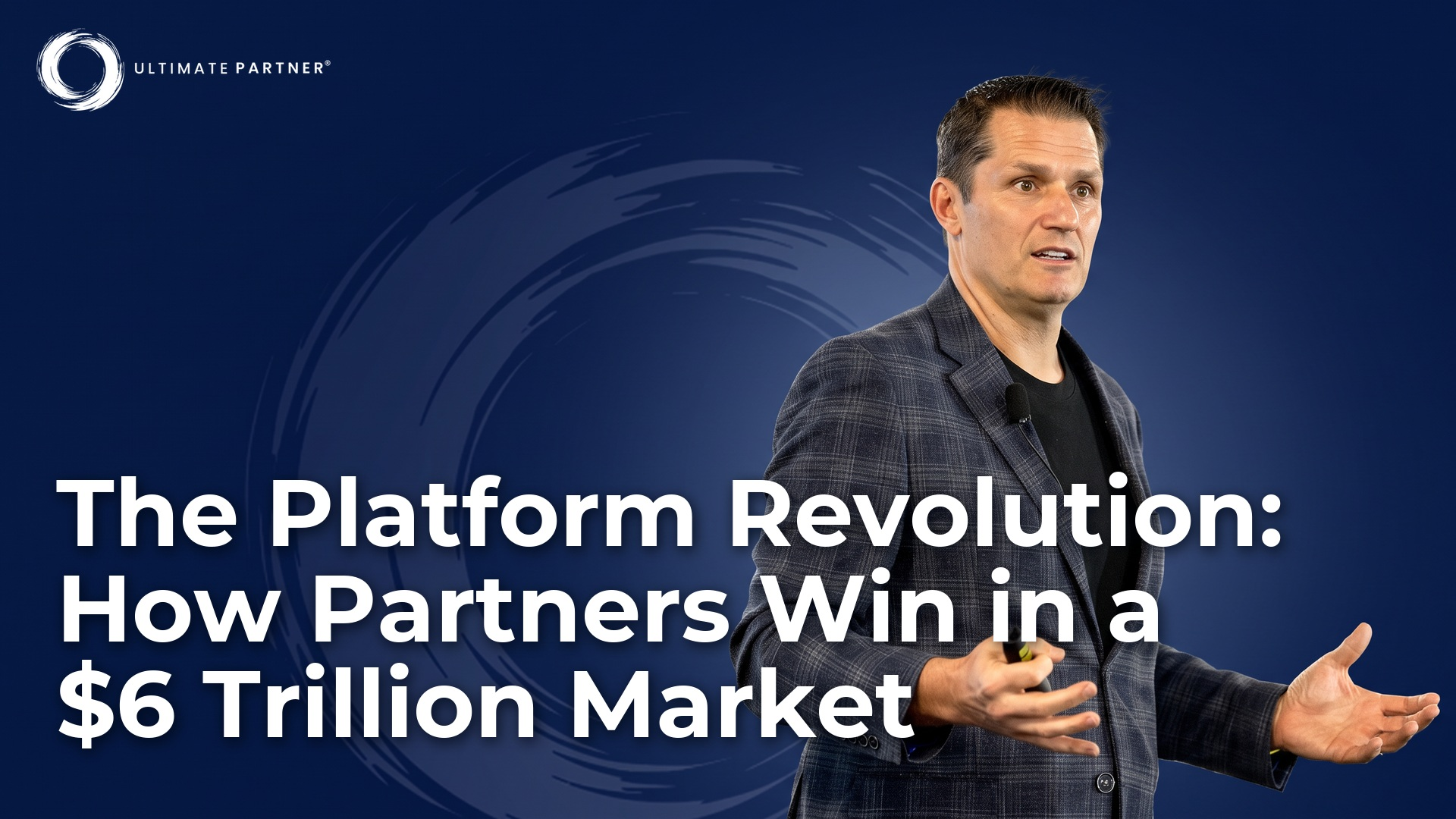
The technology industry is experiencing a massive shift as artificial intelligence drives a multi-trillion-dollar market expansion and redefines how partners deliver value. This keynote session, recorded live at Ultimate Partner LIVE in Reston, features Jay McBain, Chief Analyst at Omdia, who takes the stage to lay out the macroeconomic forces, platform dynamics, and partner strategies that will define the next twenty years of the channel.
McBain outlines how the global IT spend of $6.2 trillion is doubling rapidly, with 65.3% of transaction volume and 96% of all deals relying on partner assistance. He details the rise of open models running locally on 16-gigabyte laptops, the consolidation of neo-clouds, and the concentration of 80% of this year’s $85 billion in AI services spend within the Top 1000 partners. He explains why customers require an average of 6.3 partners per deal to address specific roles, industries, and localized regulations, and how marketplaces are growing at 82% compounded to support this ecosystem. The keynote closes with an analysis of the talent shortage, the billions in vendor investments to solve partner unreadiness, and why managed service providers must build repeatable AI practices immediately rather than waiting for RFPs.
Key Takeaways
AI certifications are the new gold standard. Just as a Novell CNE or Microsoft MCSE secured high-paying careers in previous eras, an AI certification is today’s ticket to a $500,000 role as customers struggle to find talent.
Open models are closing the gap. Frontier models hold only a six-month lead before open models catch up at a fraction of the cost. With 86% of prompts not requiring expensive cloud-based frontier models, more processing will shift to the edge on standard 16-gigabyte laptops.
The Top 1000 capture the spend. Out of $85 billion spent on AI services this year, 80% went to the Top 1000 partners. To compete, partners must move away from ad-hoc services and build repeatable, scalable practices around FinOps, sovereignty, and edge-to-cloud.
It takes a village of partners. The average deal now requires 6.3 partners because buyers demand highly specific combinations of role, industry, segment, and geographic expertise. No single firm can cover all seven layers of the modern technology stack.
Marketplaces are the new transaction engine. Cloud marketplaces are growing at 82% compounded, with companies like Anthropic routing up to 60% of their revenue through these digital channels.
Vendors are hedging their bets. Because 82% of partners are not yet ready to deliver on AI demand, hyperscalers are investing billions in direct services FTEs while simultaneously pouring over two billion dollars into partner enablement.
Chapters
00:00 How AI certifications match the career-defining credentials of past tech eras
01:48 The twenty-year eras of the technology industry
04:28 Sizing the multi-trillion-dollar partner opportunity
06:04 Why the vast majority of global trade goes through channels
08:11 The rise of the ecosystem decade and hyperscaler growth
11:21 The narrowing gap between frontier and open models
15:43 How the Top 1000 partners dominate AI services spend
18:18 Why buyers require an average of six partners per deal
19:54 Winning in a platform-centric world through integrations
23:40 Sizing the rapid growth of AI services
26:36 Overcoming the talent shortage to lower AI project failure rates
28:35 Vendor enablement investments and the direct services hedge
30:42 Why managed service providers must act early
If you’re ready to lead through change, elevate your business, and achieve extraordinary outcomes through the power of partnership, this is your community. At Ultimate Partner we want leaders like you to join us at Ultimate Partner, where transformation begins.
Subscribe to our Newsletter: https://theultimatepartner.com/ebook-subscribe/
Check Out UPX: https://theultimatepartner.com/experience/
#PlatformRevolution #AIServices #TechEcosystem #ITChannel #CloudMarketplace #UltimatePartner
Transcript
[00:00:00] Jay McBain: Your ticket to a six-figure job in 1992 was an MCSE with Microsoft, and then a CCIE with Cisco a couple of years later. Your ticket to a $500,000 FTE job today is that certification in AI.
[00:00:16] Vince Menzione: You can feel it happening. The ground is shifting beneath us. The way we partner, how AI is remaking the channel, and what it takes to win as a partner right now. I’m Vince Menzione, and welcome to the Ultimate Partner Podcast, where the leaders shaping the ecosystem tell you what’s really happening. Get ready to go deeper. The insights, the frameworks, the real moves in the market.
[00:00:44] Vince Menzione: Because being in the room changes everything, and we’re bringing the room to you now. So with that, I have an incredible friend who is also an incredible speaker and expert. My wife calls him the Count because there’s nobody that knows numbers better than this gentleman, and he flew in last night.
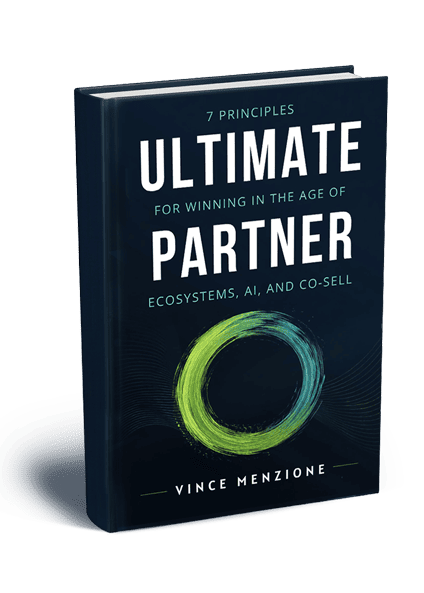
[00:01:13] Vince Menzione: Did you get in last night? Good. You got some sleep? That’s good. And Michelle’s here too? Yes? Awesome. Oh, I love that. He’s got his caffeinated drink. I don’t even know if I need to introduce you anymore because everybody knows you now, Jay McBain. Come on up on stage. Come on. Good to see you. And I think you got the jacket memo, my friend. Good to see you. And if you haven’t read the book yet, the foreword… This gentleman was generous enough to write the foreword for me. It’s been a great source of inspiration and friendship for many years now.
[00:01:44] Vince Menzione: I really want to thank you. Thank you. All right. It’s all yours.
[00:01:48] Jay McBain: All right. So if you’ve heard me before, you hear me talk about this is the fastest-growing industry, the tech industry, the telco industry for 56 straight years. Every single year since the time we landed on the moon until today, this is the fastest-growing industry. It hasn’t been linear, and every morning we wake up to a damage report of what is happening and what is changing in front of us, but it does break down into some pretty clear 20-year eras.
[00:02:21] Jay McBain: We remember, if we’re old enough, the mainframe and mini era. We might remember August 12, 1981, where Microsoft DOS version one shipped on an IBM PC. We might remember a small startup in San Francisco in 1999—ex-Oracle person Marc Benioff started Salesforce with a big ‘software’ with a line through it. A few years later, Jeff Bezos walked into the boardroom and said, ‘Do you think we could rent out some of our infrastructure on our non-busiest days?’
[00:02:56] Jay McBain: We bought a lot of stuff to support Christmas and Prime Day. It sits idle, at 20% usage the rest of the time. Not only laughed out of the boardroom, but made fun of on magazine covers. Maybe he should just tend the store. Well, ChatGPT in March 2023 is when our neighbors, friends, and family came to us as tech people and said, ‘Did we just light up Skynet?’
[00:03:24] Jay McBain: So these are the inflection points that really define our industry, and we’re in the first moments here. The first couple of years of AI has been a consumer story, and we’re just in our first year of the business story of AI. Twenty years is also important because the average company in the Fortune 500 doesn’t make it through a 20-year era. If you grab the magazine from 20 years ago today, 53% of Fortune 500 companies no longer exist.
[00:03:58] Jay McBain: If you don’t have the benefit of being in the Fortune 500 and having the deep pockets to buy your way out of problems, 71% of tech companies don’t even make it ten years according to the IRS. So this is the impact of these things. Think about as a consumer, the companies we know and love today—half of them won’t survive AI. Now, how big is this going to be? There’s lots of opinions.
[00:04:28] Jay McBain: Vince was just mentioning things in the trillions. As we play out the next three to four years, Microsoft thinks it’s $6,500,000,000,000, but it’s actually not Microsoft’s TAM. You’ll always see in the paragraph or in the quote, ‘the partner ecosystem.’ When you think about the hardware, the software, the services, the telecom that’s going to make up all of this from edge to cloud, from terrestrial now up to space, this is a big market, not to be outdone.
[00:04:59] Jay McBain: OpenAI is talking about a $7,000,000,000,000 build-out to make this happen. What makes these numbers fantastic is they’re larger than our industry today. So for 56 years, the fastest-growing industry every single year has created a $6,200,000,000,000 spend globally. If your customer is spending a dollar, they’re spending about 25¢ in hardware, about 25¢ in software, just over 25¢ now in IT services, and just under 25¢ in telco.
[00:05:32] Jay McBain: That’s how it breaks out. So you take the $7,000,000,000,000 build-out, and what took 56 years to build doubles in size in only three. So we’re here at Ultimate Partner to talk about who wins in this space—not just who becomes trillionaires, there’s probably going to be six or seven of them, but who becomes billionaires, who becomes millionaires, how do 10,000,000 partner professionals not only survive this era, but thrive in this era?
[00:06:04] Jay McBain: We know today, 65.3% of that $6,000,000,000,000 goes through partners. That’s how money changes hands. About 75% of all world trade goes indirectly. The dealerships, the agencies, the brokers, the resellers, the retailers, the franchisees, the gas stations, the grocery stores, the pharmacies—all 27 industries use channels. It’s how we buy. It’s very unique when we actually buy direct from a manufacturer.
[00:06:38] Jay McBain: Well, Jay, I bought a Dell computer in the nineties direct. Well, Dell computer is now 62% indirect using Carahsoft and others to go and drive towards this number. Well, I bought insurance direct from GEICO because fifteen minutes saved me 15%. Well, GEICO sold more insurance last year through agencies and brokers than they did on that Super Bowl ad. This is the world we live in.
[00:07:08] Jay McBain: When Tupperware doesn’t go and exercise channels like Amazon and Target, it goes bankrupt. We hear these stories all the time. Nike gets McKinsey in with brilliant thinking: ‘We’re going to go direct, we’re going to go out of categories, we’re going to change the game at Nike.’ Their stock price drops 90% and they went back to all their retailers and kind of went, ‘Oops.’ And their retailers kind of went, ‘No. We got kind of cool new shoes at eye level.’ This is a problem, and channels of distribution are a big part of it, but the 65% is not why we’re here.
[00:07:41] Jay McBain: It’s the 96%. This is a number that a Microsoft or a Cisco would have told you 20 years ago that they measure every day—the deals they have in their CRM system that are partner-assisted, partner-sourced, partner-surrounded, whichever metric. It’s basically everything. And in the 4% that we don’t have partners, it’s just because we’re not measuring to that level. We’ve got to improve our measurements because we think it’s 100%. This industry doesn’t work without it.
[00:08:11] Jay McBain: This was the trigger for this decade of the ecosystem. We had a decade of sales. We had a decade of marketing. You put those two things together in the 28 moments that your customer spends between having a problem and solving the problem, it’s all partner-assisted or partner-surrounded throughout that. Now there’s lots of ways to measure the decade of the ecosystem, watching, for example, the hyperscalers, but then you see at the very end here in the last couple of quarters, the hockey stick starts again.
[00:08:43] Jay McBain: If 30% growth isn’t enough on a $600,000,000,000 market, all of a sudden now we’re growing at 82 and 62 and 52. These are things that we’re talking about today in terms of winners. So Anthropic and OpenAI being here, something happened that we’ve never seen before. Anthropic in 20 months, less than two years, became larger than IBM, Cisco, HP, SAP, Oracle, Intel, Lenovo, whoever you want to talk to or friends of the channel, many of them here, which took IBM 112 years, took HP 82 years, and took the rest of them about 50 years.
[00:09:27] Jay McBain: Anthropic did it in 20 months. So that’s what we’re here to talk about today—this new inflection point that we’re at and then how do partners look at this and survive. There’s also something else that’s coming up, and these are brand new charts from yesterday. So Anthropic yesterday filed its final filings before the government, before IPO, and what was a $2,000,000,000,000 looks like a $1,500,000,000,000 today IPO, but I want to tell this story because of the durability of that revenue to go from a billion dollars to $100,000,000,000 within the course of 18 months, and asking where the durability is.
[00:10:16] Jay McBain: So the one thing we do know, and this is how we’ve been conditioned as humans: when we ask Alexa, the hockey puck that sits in our kitchen, we just assume that our question goes to the cloud because that hockey puck doesn’t have much intelligence other than the ability to do that. When we ask Siri, which we’ve been asking Siri now for 15 years, or we’ve been asking the hockey puck for 12 years, we’re just conditioned that whatever we ask—the weather, whether the Cowboys won last night, what am I doing later today—
[00:10:49] Jay McBain: We just assume that there’s this move to the cloud and there’s powerful models that take it to the next level, and they’re ahead of Moore’s Law. They’re not doubling every 18 months; they’re doubling every 12. So the new models that we have just in the last few weeks are twice as powerful as the ones we had last year, but again, we’re conditioned as humans to expect this, and I know next year that I’m going to have the next version of this, two times faster and bigger and better than it is today.
[00:11:21] Jay McBain: But there’s another underlying story of value here that’s important when you think about how this is all going to shake out, and it actually sits here. These massive models, the frontier models, have a very small head start. They are within six months of open models catching up.
[00:11:50] Jay McBain: So to say it this way, those models that we knew and loved last year, there’s already four open models that perform much better, and they’re closer to today’s models than they were to yesterday’s models at a significantly different cost. The other thing we’ve watched is OpenRouter getting acquired for $13,000,000,000, but understanding that sitting on top of these models, again, we’re conditioned that asking whether the Cowboys won last night ought to go to a frontier model and burn $5 of NVIDIA power and water.
[00:12:24] Jay McBain: Well, the answer is no. 86% of every prompt from consumers and business do not need to go to the latest frontier model. It would have been fine solving with last year’s model or solving with an open model. So the one thing we’re not presented with today is a price. So when you ask AI a somewhat complicated question, what if it came back and said, ‘Do you want it to solve for $5?’
[00:12:52] Jay McBain: Do you want me to solve it for 5¢, or do you want to go grab a cup of coffee and your Mac Mini is going to go solve it in ten minutes? So this is the new model. The runway and the lead is narrowing. That six months is getting less, not more, and these open models can now run—I didn’t know this was building—on your PC.
[00:13:21] Jay McBain: So last year’s frontier model can run on your laptop with like 16 gigs of memory. And by the way, the battle of the edge isn’t about neural nets and all these neural processors and how many NVIDIA things can get on the motherboard. It’s just about memory. If you have a laptop with 16 gig, you’re running last year’s frontier model. But if you upgrade your laptop to 32, or you get a Mac Mini, or you get a Mac Studio, or Lenovo, or Dell, or HP—if you walk into any PC with a relatively high amount of memory, you can run an open model that’s very close to a frontier model locally.
[00:14:03] Jay McBain: This is durability of revenue. Today, there is no OpenRouter sitting on top of every prompt. Today, there is no prompt at how much each of these are going to cost. But as we go forward, as companies talk about FinOps, as they talk about sovereignty, as they talk about all these different really detailed things, which they are, this is the conversation we’re having. The impact of edge to cloud and where prompts go and how this all plays out in this $7,000,000,000,000 we’re talking about has impact everywhere.
[00:14:37] Jay McBain: Again, if we get less conditioned that everything we ask has to go to an expensive model sitting in an expensive cloud, and it can process in my watch, in my phone, in my humanoid robot, more of it happens at the edge. It changes all of the economics. It changes the value. It commoditizes layers that we wouldn’t expect, and it touches everyone. Neo-clouds—Elon Musk raised money yesterday, and in a side comment said that there is no more capital for neo-clouds.
[00:15:09] Jay McBain: Over 200 companies who are running massive debts don’t have any more access to capital. So the prediction is 200 roll back into seven to 10 neo-clouds in the next few years. The frenzy is over. This morning’s news around the hyperscalers, the frenzy is over. This is all backed up by the semiconductor industry. It’s all backed up by infrastructure companies. This has a big ripple effect on what we do, but again, this isn’t a partner story yet.
[00:15:43] Jay McBain: So one thing, and I showed you last time if you were here, we spent years creating the Partner 1000. We didn’t have our own Fortune 500 in our industry, oddly enough 46 years later, but now we do, and the second one is just about to come out in a week. It takes about $67,000,000 in services as a partner to become one of the thousand, and Accenture sits on top with 776,000 employees. But I would have told you last time that two-thirds of all the tech services in the world, $1,400,000,000,000 of tech services, two-thirds of them happen here.
[00:16:21] Jay McBain: That’s your top-down view. But now six months later, we’ve measured the $85,000,000,000 of AI services that customers have actually spent this year, and we know that 80% of them have happened here. So any company that wants to win in the AI era, which is everyone here, 80% of it is top-down here. Names, faces, places of exactly where it’s happening.
[00:16:49] Jay McBain: We also know more now about why there’s 6.3 average partners in every deal. It’s not just that millennials like people. It’s not that millennials like a team sport. It’s that millennials are getting much smarter as buyers, and so are Gen Z behind them. Now, I have a certain role to play in my company. I might run a department or a division. I want somebody that sat in my shoes, spent 20 years literally living in my shoes.
[00:17:20] Jay McBain: I’m going to get fired next week, and I want somebody to know exactly why I’m going to get fired. I don’t care about their technical skills. I don’t care where they live. I don’t care about anything else other than they’re going to take me through this inflection point. I want somebody that understands my industry—not just the 27 banking, insurance, automotive. There are 12 sub-industries. I’m sitting with compliance and regulatory. I’ve got all things going on, competitive. I want somebody in the room that understands that.
[00:17:50] Jay McBain: Again, I don’t care about their technical skills, don’t even care if they know what role I play as a vice president. I want somebody that understands where I live by state, by province, by country, and understanding my level of sovereignty and the things that are surrounding me. That localization is really important in AI. So as a segment, I might have 50 employees. I have 500. I have 5,000. I have 50,000.
[00:18:18] Jay McBain: My capabilities and capacity to execute—I want somebody that’s lived in this part. I don’t want them talking about big banks when I’m a mid-sized bank. I want them to understand where I am and what kind of resources I can bring to bear. And then I understand the technology. It’s going to be a seven-layer stack, and there’s probably not one jack-of-all-trades that knows everything. If I pick on the SaaS industry, G2 Crowd this morning has 2,262 categories of SaaS.
[00:18:50] Jay McBain: 250,000 companies competing. SaaS makes up 10% of our customer’s budget. You can imagine when you move past the SaaS layer into cyber, into data, into AI, into infrastructure, into cloud. If you roll up the seven layers, who do I have to surround me that can talk from edge to cloud, from terrestrial to space, and fill in how I’m going to execute this? And then finally, people that are good at what they do.
[00:19:20] Jay McBain: If I’m asking for an adviser, a consultant, a designer, an architect, an implementer, an integrator, a managed service provider—what makes a great consultant may not make a great integrator. What makes a great designer/architect may not make a great managed service provider. I want somebody expert in what they do and what they’re delivering at that point of my journey. So if I’ve just explained to you why I need six people at least, and as you get into larger enterprise and into government, you’re going to be north of 10 to even 20 partners in the room that are bringing in deep-level expertise.
[00:19:54] Jay McBain: The winning companies today, the most valuable, the fastest-growing, are living the platform world. It’s kind of what we’re anchoring on here and what Vince’s great book did a lot of detail around: how are they winning? What do the chapters of the book look like? Well, in the upper right, I need more integrations than my competitors because my new buyer—51% of my buyers are millennials—it’s their number one buying criteria. Integrations are ahead of service level, support, price, and brand reputation.
[00:20:26] Jay McBain: If I don’t have more integrations, I lose. My new buyer will buy a product 80% as good as the next one if it works better in their environment. So again, integration is important. I have to know some of the 6.3 people that support the customer. It could be channel partnerships 65% of the time—the distributor, the reseller—but it’s also the consultants, the advisors, the designers, the implementers, the integrators. If I don’t surround the customer, I miss those moments, and if I create undue friction in my sales cycle, my marketers and my sellers won’t be successful.
[00:21:04] Jay McBain: So who does that better than their competitors? Who builds stronger alliances? Knowing that most of the time we compete in the morning, but we’re best friends by the afternoon. An alliance isn’t a press release. It’s deep-level co-selling, co-marketing, co-innovation, co-development, co-keeping with the companies that are in our seven-layer stack. And then finally, building out our go-to-market.
[00:21:34] Jay McBain: Do we understand these 28 moments better than our competitors? Do we have the measurements? Do we have the technology? Many of the companies here today sponsoring are building the technology that lands us better in front of our competitors in those 28 moments. But two-thirds of our industry is subscription- and consumption-based, now micro-consumption with tokens. So winning a customer today is only winning the first 30 days. What am I doing with those 6.3 partners every 30 days forever to not only get a customer for life, but to renew them at 108% every single cycle?
[00:22:11] Jay McBain: That’s the economics that our investors want, Wall Street wants. This is the play-out of how to build a platform model that’s defensible, that’s defendable, and again, that’s 10% better than our competitors day in, day out throughout the year. Are we participating in the rush in marketplaces growing at 82% compounded? What have we learned from the 17 companies that have issued press releases that they’re in the billion-dollar club?
[00:22:40] Jay McBain: How… What did they do with their people? The processes. Now, agentic processes and workflows. What did they do with their programs? What did they do with their technology? When they went to Ignite, when they went to re:Invent, when they went to Next, how did they play it out to get into this category? How are they playing the economics? If this is part of my competitor, it’s not just cyber companies. It’s not just data companies. You have the two frontier models on here now. You have partners on here like Presidio and WWT.
[00:23:10] Jay McBain: So this is expanding. And by the way, there are 20 companies that are a billion that haven’t released their press release yet. The other thing that we found out in these latest filings by Anthropic is that they were 17% through the marketplace, then they were 23%, then last year they were 47%. They could be upwards of 60% today of their revenue, and if they hit $100,000,000,000, each of the lines in that growth model double in size.
[00:23:40] Jay McBain: The important thing is how do partners win in this $7,000,000,000,000 build-out. Last time I said that there is a 32.5% growth rate in AI services compounded over the next five years. So your customers, to just set the baseline, are growing at 2.77%. World GDP is growing at 2.7%. If you’re in managed services, for example, they’re growing at 10% compounded.
[00:24:12] Jay McBain: If you’re in cybersecurity services, they’re growing at 12% compounded. Triple that, and 10 times what your customers are growing at, is AI services. So we were able to give a view of the hundreds of AI services that now make up the $85,000,000,000 in what customers spent this year. And we could take that $85,000,000,000 out to $347,000,000,000 by 2031.
[00:24:43] Jay McBain: So if we understand, again, names, faces, and places, the detail level of where partners can compete at a service level—again, moving through advisory, into consulting, into design through the 28 moments, not theoretically, not in a framework or a flywheel or a force multiplier, but literally what’s being invoiced today and what’s working today in terms of customer feedback. And then the smartest partners are not out to win ad-hoc services.
[00:25:16] Jay McBain: You’re not out there in the market trying to win hundreds of services and just take what you can get because that isn’t profitable. What happened in the cloud era, what happened in client-server is you build practices. And if you can build a practice that’s repeatable and scalable as a partner, you can be profitable. Then it’s off-the-shelf; you don’t have to reinvent the wheel every time you engage with a new customer.
[00:25:51] Jay McBain: And the story about FinOps, about not getting tokened to death, the story about sovereignty. If you go over to Europe—I spent last week in Italy and Spain—the story about building closer to the edge because of government regulation, because of compliance, because of other reasons. All of these different things, from cybersecurity to managed services and optimization to building out edge-to-cloud, all of these things become repeatable practices. And so these Top 1000 partners are looking for your help in terms of building this moat around their services and defending it against the industries, the buyers, the segments, the different product sets, and things like that.
[00:26:36] Jay McBain: That’s what they’re looking to do. But when we surveyed the world, it was actually this week last year that the number one story in the newspaper was the MIT report: 95% of all AI projects or proofs of concept fail. That was last year, only a year ago. Well, this year we passed 70% early this summer. By the end of the year, it’s going to be less than 50%. We solved that problem—at least half of it—in only 12 months.
[00:27:04] Jay McBain: So what we’re relating to now is when we went to customers throughout the year and said, ‘Tell me all the reasons for failure. Was it a data access problem? Was it a data cleanliness problem? Was it a data security problem? Was it a compliance problem?’ List off 99 problems, and number one was talent. We don’t have the people. Ironically, if you go back through those 20-year eras, it was the number one complaint at the start of cloud.
[00:27:36] Jay McBain: We need to outsource to go get talent. If I want to drag you back to the 1980s, it was the number one issue in client-server. As things started connecting together and as the Internet was starting to get its forming, that was the number one issue. Your ticket to a six-figure job in 1989 was a CNE, a Certified Novell Engineer. Your ticket to a six-figure job in 1992 was an MCSE with Microsoft, and then a CCIE with Cisco a couple of years later.
[00:28:06] Jay McBain: Your ticket to a $500,000 FTE job today is that certification in AI. It’s all over again, but for 46 years, it’s been the same thing. Customers can’t find and can’t afford the talent necessary to take them to success, and therefore, they will outsource more tomorrow to partners than they did yesterday. 82% of partners, however, are not ready.
[00:28:35] Jay McBain: So this is where it gets interesting in surveys: ‘Well, what do you mean 82% of you are not ready to grow at 32.5%? You’re not ready to take on the demand that’s already coming.’ Well, who do you blame for not being ready? Why blame vendors? Okay. But why do you blame the vendors? Well, they spent two years hyping AI. Every week, you go to Las Vegas and somebody rents out the Sphere and puts it on the side of the Sphere, and their CEO jumps up and hypes AI.
[00:29:05] Jay McBain: $7,000,000,000,000—this is going to be our piece of it. But they didn’t spend the time enabling us to go surround the customer and go deliver on AI, and now they do. Google wrote a $750,000,000 check, Anthropic wrote $100,000,000, OpenAI wrote $150,000,000, SAP wrote €100,000,000, and Salesforce wrote $50,000,000. Everybody—Oracle just jumped in with a billion-dollar investment in enablement. So they’re trying to solve the 82% problem. Let’s get that—
[00:29:34] Jay McBain: Get our partners ready to go grab that demand, but they’re also hedging. This is the first time in history that we’re going to build out direct services called FTEs. So Microsoft commits $2,500,000,000 in FTEs and then yesterday puts a buyout for 60,000 people. AWS buys a billion dollars in FTEs. Google doubles that $750,000,000 with $750,000,000 in FTEs.
[00:30:04] Jay McBain: We’re going to hedge against the partners not being ready by sending in our own people. We’re not services companies. All of those people are going to go back to the channel probably in three or four years, but our investors are all over us to get this right, to get that 95% to zero, to have everyone out there finding returns on AI, and we’re going to spend both ways to make it happen. We’re going to be the 7.3rd partner around that customer to make it happen, and hopefully, the other 6.3 can watch us and we can hold their hand to get them to that level.
[00:30:42] Jay McBain: So that’s what’s happening is this hedge, and we know that the final thing I’ll say is over the next five years, it’s also not the same services. So there’s something that’s happened, for example, managed service providers waited almost to the end of the client-server era, 20 years in, until everybody figured out that PCs are a horrible total cost of ownership. It might cost $1,000 to buy but cost $10,000 to service it. I sold PCs for 17 years.
[00:31:12] Jay McBain: I get this. And then managed service providers said, ‘Well, for $113 a month, I can come do it.’ It’s predictable, it’s great, and it solved the problem. For cloud, it took a long time to figure out how am I going to manage SaaS or cloud infrastructure when I don’t physically have the product to work on. It’s not a physical thing. Well, they figured it out. It’s happening. But managed service providers can’t wait because last week, Accenture—I mentioned number one on the list with 776,000 employees—reported their earnings.
[00:31:46] Jay McBain: They’re now a bigger managed service provider than they are a consultant. So when Accenture is winning advisory and consulting, design and architecture, do you think they’re going to step back and allow the customer to RFP for managed services? They’re not, and nor is anyone on that Top 1000 list. So nobody’s going to sit back and wait for an RFP. They’re all in. Every partner’s all in at everything. The average partner’s doing 3.2 different business models.
[00:32:15] Jay McBain: We’re a consultant in the morning. We’re a designer in the afternoon. Next morning, we’re a managed service provider driving optimization of AI, driving security, driving governance. This is the surround of the future. And so the competition changes, and as the next five years go on, as things get to the point where we can operationalize them, there’s not a new channel that’s going to step in. I had 3,600 MSPs in Spain last week. This is not just a sit around and wait for our opportunity a year from now.
[00:32:44] Jay McBain: It’s going to be captured by the companies in there early in those 28 moments. So this is the winners and losers. That’s who’s going to make money and not only survive but thrive in the $6,200,000,000,000 industry and the next $7,000,000,000,000 that comes. Thank you so much.
[00:33:04] Vince Menzione: Thank you for watching. Thank you for listening to this episode of the Ultimate Partner Podcast. You can find us at theultimatepartner.com or on YouTube at Ultimate Partner. Thanks again. Just kidding. We got tomorrow. We got a busy day tomorrow. I can’t thank you enough. I don’t know where to start.
[00:41:21] Tony Safoian: Only for you, Vince. Only for you.
[00:41:26] Vince Menzione: Thank you for watching. Thank you for listening to this episode of the Ultimate Partner Podcast. You can find us at theultimatepartner.com or on YouTube at Ultimate Partner. Thanks again.